
Where Am I, part 3
Heading into the season of darkness…

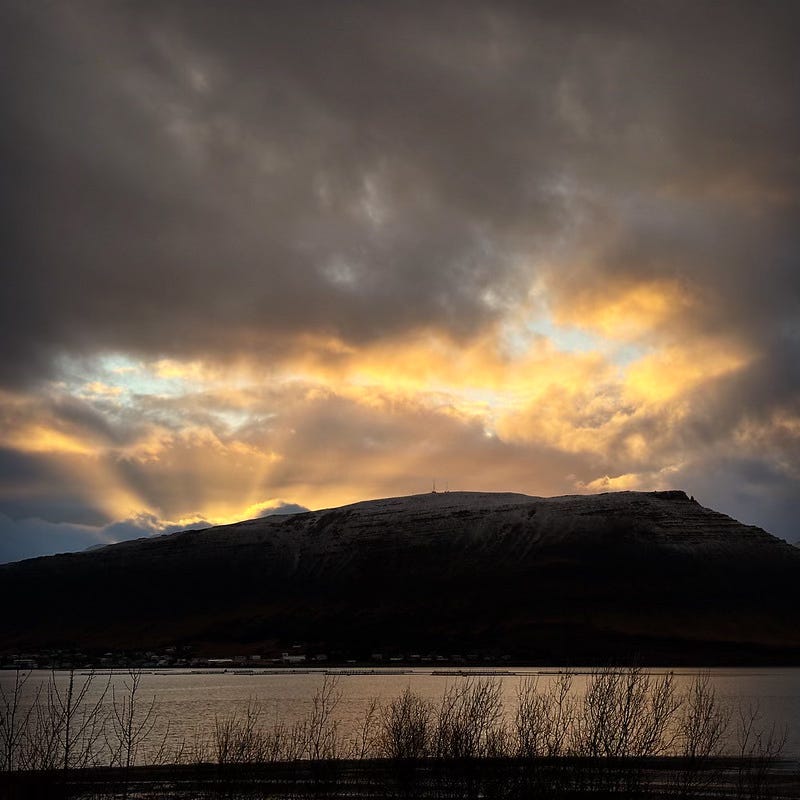
Here in the Westfjords, the sun is going behind the mountains for its winter rest—or rather, its winter pacing behind the curtains. It’s still there, and we still have daylight, indirect brightness rather than direct beams of sunshine but brightness nonetheless—but no question, we have less and less of it.
Technically Iceland is mostly a sub-Arctic island; only the tiny dot of Grímsey, an island roughly 40 km (25 miles) north of the northern shore of Iceland, is crossed by the Arctic Circle itself. The latitude of my house here on the shore of Dýrafjörður is 65.89°N, the Arctic Circle arcs around 66.34°N—so we’re juuusssttt below it. If my southern horizon was perfectly flat at sea level, I would still get sunshine briefly on the winter solstice (my birthday!)—but because it is most emphatically NOT flat, but populated with mountains sometimes called the Icelandic Alps, the low winter sun vanishes behind the peaks for nearly two months. If there are clear skies and I happen to be home at midday, I get my last direct sunshine on November 26th (today I’ll miss it, I’ll be up in Ísafjörður getting stitches taken out of my hand from recent carpal tunnel surgery), shining for about 90 seconds over Hrafnseyrarheiði, the old pass over which the primary road through the Westfjords used to run, that happens to be due south from my porch. After that, no sunshine here until January 16th (my nephew’s birthday!), again weather permitting, unless I climb up to a higher elevation somewhere to peek over the mountain tops.
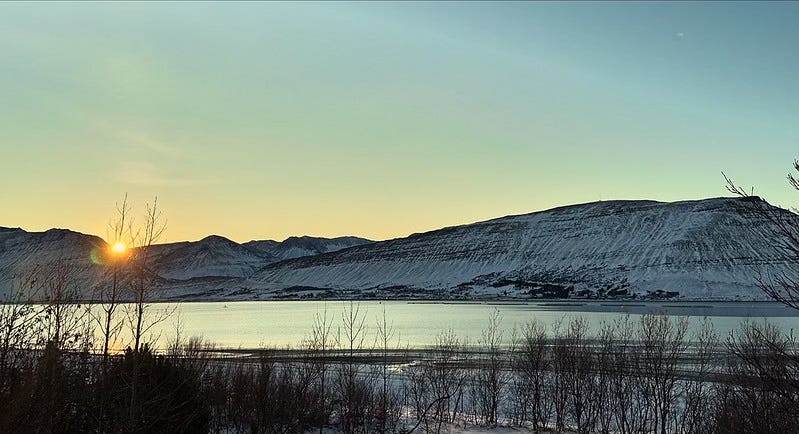
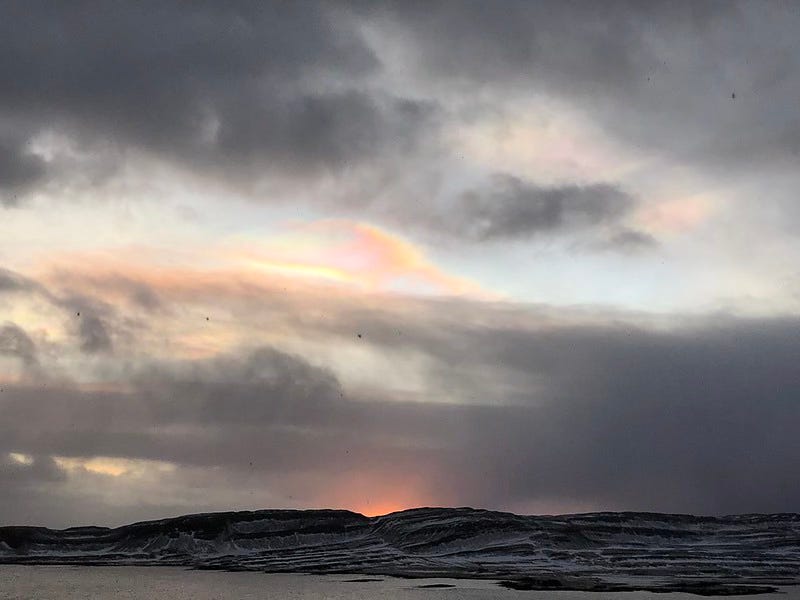
People often ask how I manage my mood through the winter darkness here. I’m fortunate to not suffer from seasonal depression, no need for special lights or etc. (My mental health can actually suffer far more in the summer, when constant brightness makes sleep extra-challenging, plus I miss seeing stars.) But I also feel compelled to explain that our winters are not completely dark—we still have roughly 4-6 hours of daylight (date-and-weather-depending), and long mercurial twilights of deepening cobalt blues that last about two hours on each side of the day. And that the indirect light of December and January is magical: it creates an unimaginable array of delicate pastels across the sky; sometimes we get glitský, or polar stratospheric clouds, which look like rainbow oil-slicks oozing everywhere; and snow glows under indirect light as if it were electric. Plus, of course, plenty of northern lights.
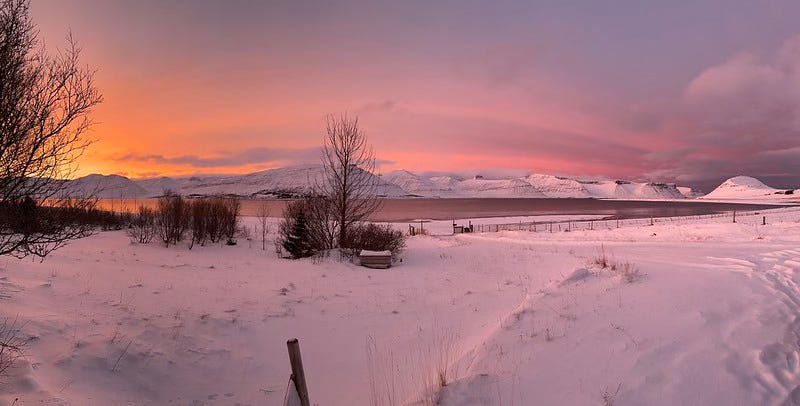
So the darkest months are counterintuitively one of my favorite seasons here in Iceland. Each town, each household knows exactly which day the sun vanishes from it’s specific topographical location (and of course when it returns again in January, celebrated with sólarkaffi, which is Icelandic pönnukökur or sun-shaped pancakes eaten with rhubarb jam and whipped cream, plus lots of strong coffee). It’s become my tradition to put up my holiday lights on November 26th—will see if my hand is up to it later today.
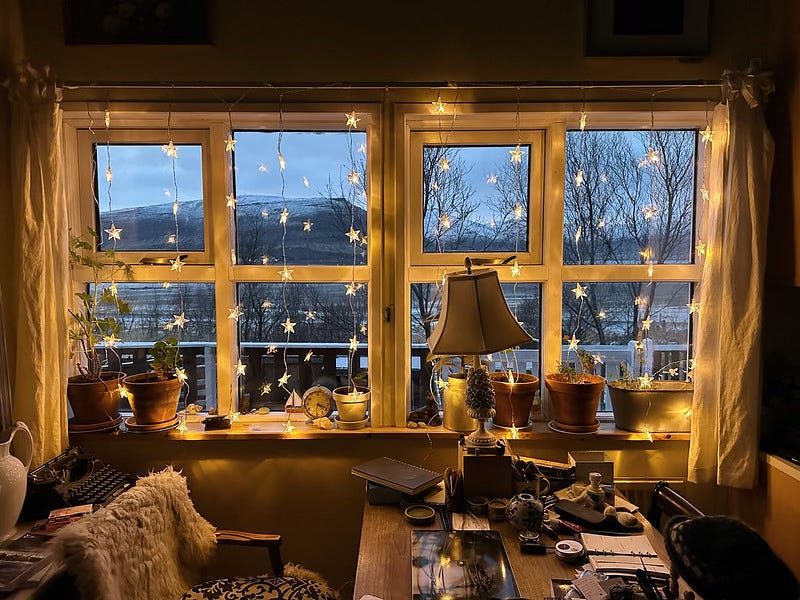
And happy thanksgiving this week to those of you reading from the U.S.!
The extra summer sunshine being tough makes sense to me. Many years ago, I was in Stockholm for a conference during the first week of July. I woke up with a start every morning thinking I had overslept because the sunshine was streaming in my window. But in fact, it was still really early in the morning and I had hours more to sleep
Thanks for writing about this. As someone who follows your photos on Flickr, the place you live looks amazing, but brings up questions of what it's like to actually live there. It hadn't occurred to me that all the light in the summer would be problematic, but sure, how do you sleep with twentyfour hour daylight? Blackout curtains i guess. And why do you miss the stars? Do they not shine through at northern latitudes? Very interesting Laura, thank you for your photos and descriptive experience.